


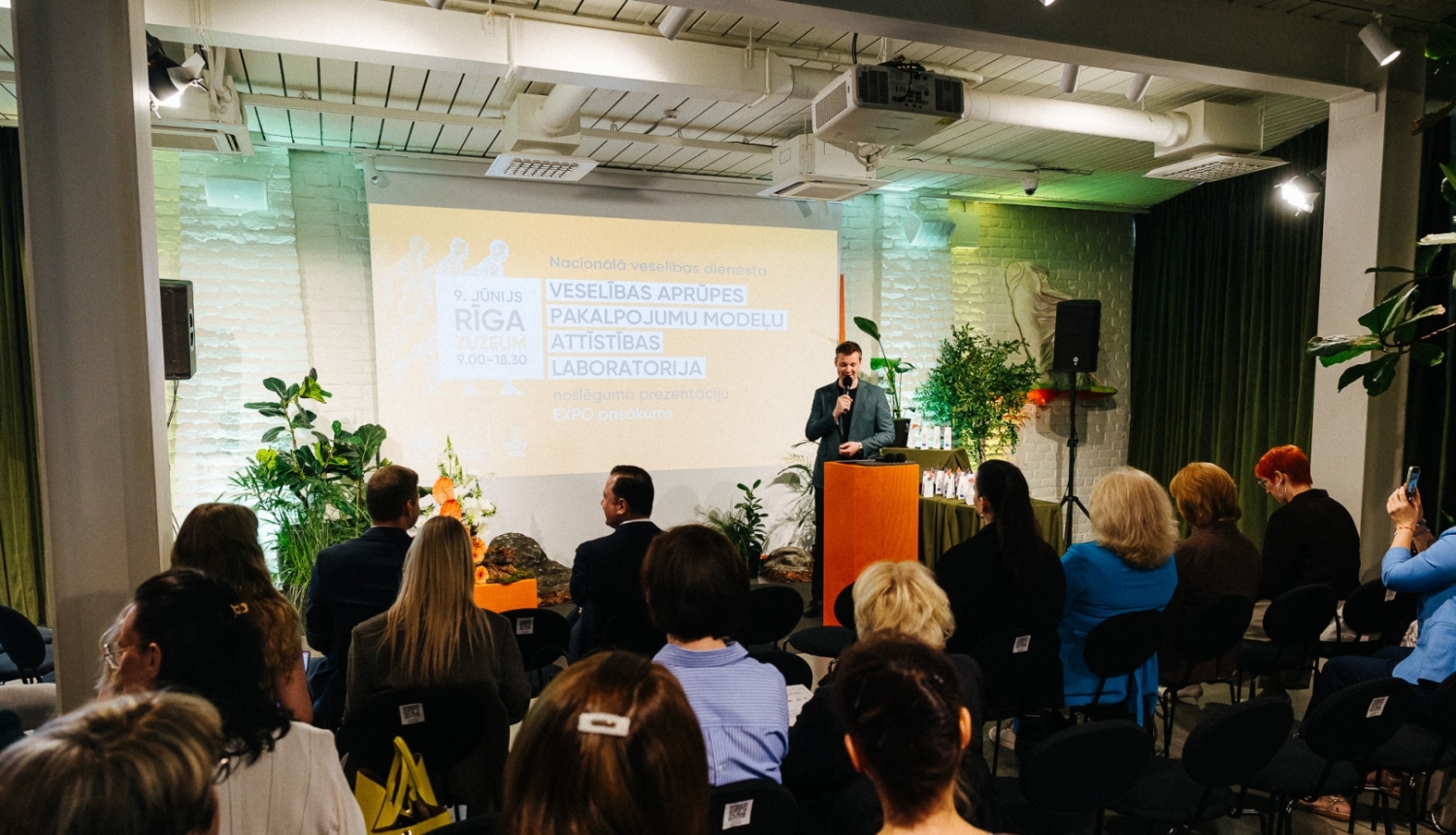
On 9 June 2026, the closing EXPO of the project “Healthcare Service Model Development Laboratory”, implemented by the National Health Service (NHS), will take place at the ZUZEUM Art Centre in Riga as a special in-person event with a live broadcast. During the event, representatives of 18 pilot projects will present the results achieved and tested in real-world healthcare settings, demonstrating their potential to become part of publicly funded healthcare services.
The pilot projects cover a broad range of healthcare areas and are aimed at enabling patients to receive more accessible, effective and modern healthcare services in the future, while allowing the healthcare system to adopt innovative and evidence-based solutions to strengthen the quality and sustainability of services.
“Medicine and healthcare are changing rapidly across Europe, driven by innovation, technology and demographic trends. In these circumstances, we must be able not only to adapt but also to purposefully introduce new, evidence-based approaches. The pilot projects implemented as part of the National Health Service’s ‘Healthcare Service Model Development Laboratory’ demonstrate how innovative ideas can be transformed into solutions that have been tested in practice. A range of healthcare service models have been developed and tested in real-world settings, including solutions to improve the quality of life of cancer patients, enable more accurate disease diagnosis, provide more effective rehabilitation, enhance pharmaceutical care, and improve access to mental healthcare. I would like to thank the patients, healthcare professionals and all partners for their involvement. We have created valuable healthcare services that are justified both in terms of cost-effectiveness and benefits to patients, and I believe that they will gradually be included in the range of publicly funded healthcare services,” says Minister for Health Hosams Abu Meri, commenting on the significance of the project.
The pilot projects began testing their viability, effectiveness and potential for implementation in everyday healthcare practice in August 2024. Their results will provide an important basis for decisions on integrating the most successful solutions into publicly funded healthcare. Several pilot projects use artificial intelligence and digital solutions in the provision of healthcare services, including patient monitoring, triage, improving the efficiency of data analysis processes, conducting examinations, monitoring the course of treatment, prescribing medicines, and other applications.
“The project’s closing EXPO is an opportunity not only to learn about the results achieved by the pilot projects, but also to see how innovative solutions can improve the quality, accessibility and efficiency of healthcare services. During this period, the pilot projects have worked to demonstrate their potential in real-world conditions, and the experience gained will provide an important basis for decisions on integrating the most successful solutions into publicly funded healthcare. Our goal is to ensure that patients throughout Latvia have access to modern, evidence-based and sustainable services,” emphasises Āris Kasparāns, Director of the National Health Service.
The EXPO will take place in person, while anyone interested will also be able to follow the pilot project presentations via a live broadcast on the NHS YouTube channel.
As previously reported, with the aim of introducing innovative solutions into publicly funded healthcare and improving access to services, the NHS, with funding from the EU Recovery and Resilience Facility, is implementing the project “Healthcare Service Model Development Laboratory” under Component 4 “Health” of the EU Recovery and Resilience Plan, Reform and Investment Area 4.3 “Sustainability of Healthcare, Strengthening Governance and Efficient Use of Healthcare Resources”, within Reform 4.3.1.r. “Sustainability of Healthcare, Strengthening Governance, Efficient Use of Healthcare Resources and Increasing the Overall State Budget for the Healthcare Sector”.
More than EUR 16 million from the EU Recovery Fund has been allocated for the implementation of the project.